California's smoke alarm and carbon monoxide alarm laws were not amended for 2026, but that is exactly why they are easy for a busy property manager to overlook. Under Health and Safety Code section 13113.7, every dwelling unit intended for human occupancy must have smoke alarms approved by the California State Fire Marshal, and the law has not changed. What has changed is that the earliest alarms sold under the state's newer battery and labeling rules are now old enough to be approaching the end of their service life, which makes fall a practical time to check every unit in a portfolio.
Since July 1, 2014, battery powered smoke alarms sold in California must contain a non replaceable, non removable battery capable of powering the alarm for at least 10 years. Since January 1, 2015, listed alarms must also display the date of manufacture, provide a place to write the installation date, and include a hush feature. Existing, working alarms installed before those dates are not required to be replaced, but the state's own guidance says smoke alarms should be replaced every 10 years or per the manufacturer's instructions regardless of when they were installed.
Carbon monoxide alarms follow a separate rule
Since July 1, 2011, the Carbon Monoxide Poisoning Prevention Act has required carbon monoxide alarms in any single family home with an attached garage or a fossil fuel source, such as a gas furnace, water heater or fireplace. Multi family rentals were required to comply by January 1, 2013. Alarms must be installed outside each separate sleeping area, and a home with more than one level generally needs an alarm on each level. Combination smoke and carbon monoxide alarms are allowed as long as the device is independently approved by the State Fire Marshal for both functions.
What to check on a fall walkthrough
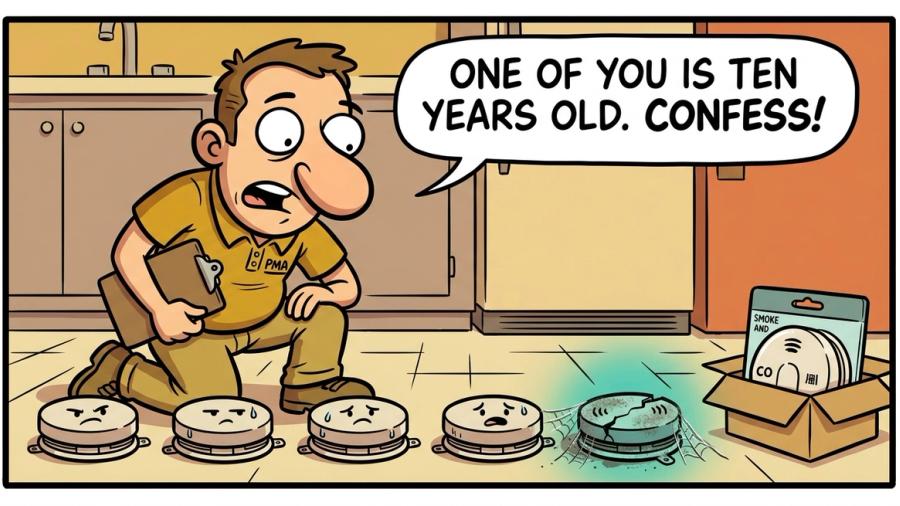
The manufacture date is the detail that gets missed. It is printed on the back of the unit, not on the visible face, so a device has to be taken down or turned to be read. During a walkthrough, check that date against the alarm's expected service life, test every unit with its button, and replace anything that fails a test or shows a manufacture date past its expected life. Placement matters too: a smoke alarm belongs in every sleeping room, outside each sleeping area, and on every story, with carbon monoxide alarms outside sleeping areas wherever a gas appliance, fireplace or attached garage is present.
Keeping the record, not just the alarm
A simple device inventory, noting each alarm's location, model and manufacture date, turns a fall walkthrough into a five minute check instead of a room by room search. Photographing each alarm in place at move in, and again at any turn, creates a record that shows the units were installed, tested and within their service life. That record is worth as much as the alarm itself if a habitability question ever comes up, since a working alarm that cannot be shown to have been tested is a weaker position than one with a dated photo and a logged manufacture date behind it.
The law has not changed, but the alarms installed under it are aging, and a portfolio wide check now is far simpler than responding to a single unit's failure later.