Since January 1, 2026, California landlords have carried explicit new duties once a disaster is officially declared, under Senate Bill 610. The law adds sections 1941.8 and 1941.9 to the Civil Code and covers events such as fires, floods and earthquakes, but only once the Governor or the President has declared a state of emergency for that disaster. For anyone maintaining rentals in California, SB 610 turns disaster cleanup from a gray area into a defined landlord responsibility.
Before SB 610, landlords already carried a general duty to keep a rental unit habitable. What the new law adds is specific: once a covered disaster is declared, a landlord must take steps within a reasonable time to remediate disaster related damage, including removing debris and mitigating hazards such as mold, smoke, smoke residue, smoke odor, ash, asbestos or water damage. Any cleaning or remediation protocol issued by a government authority must also be followed, including the use of licensed remediation contractors where required. The law does not spell out exactly what remediation service is required in every case, so the presence of disaster related debris is what triggers the duty rather than a fixed list of tasks.
A presumption that changes who has to act first
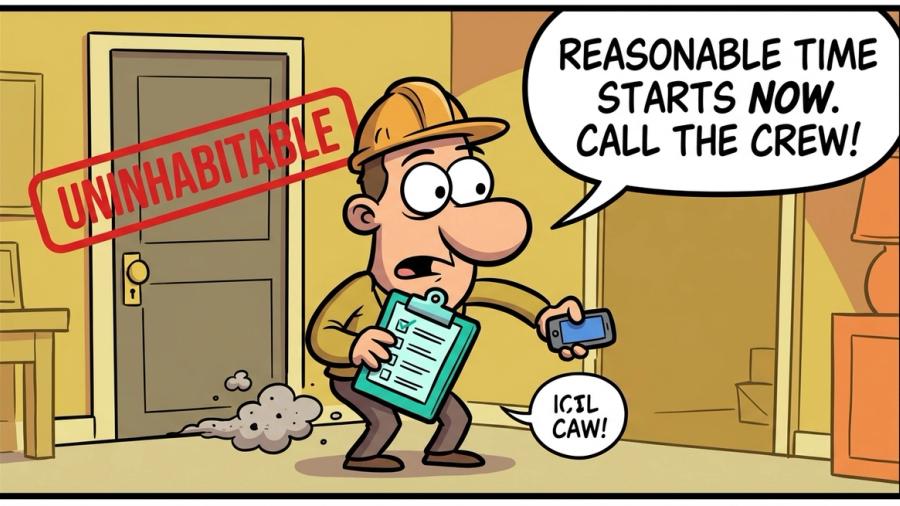
One of the more significant pieces of SB 610 is a legal presumption: once a covered disaster leaves debris behind, the unit is presumed uninhabitable until a local public health agency or official determines that the debris does not contain toxic substances. That shifts the practical burden toward landlords to move quickly and document what they did, rather than waiting for a tenant to prove the unit is unsafe. SB 610 also suspends a tenant's rent obligation during a mandatory government evacuation order, and requires prepaid rent and security deposits to be returned if a unit becomes uninhabitable because of the disaster.
Not every disaster obligation is open ended. The law is clear that landlords are not required to rebuild or repair a unit that has been completely destroyed. Where repairs are possible, landlords must notify tenants in writing once remediation is complete, which is also the point at which a tenant's right to return is triggered.
Building the remediation record before it's needed
The practical work sits in three places. First, an inspection process that can move fast once a disaster is declared, so a property can be assessed and either cleared or flagged before a tenant has to ask. Second, a short list of licensed remediation contractors for smoke, ash, mold and water damage that can be reached quickly, since sourcing a licensed contractor for the first time during an active disaster wastes valuable time. Third, a documentation habit: dated photos of the property's condition, a written record of what remediation was done and when, and copies of any protocol issued by a government authority that the work needs to follow.
That documentation matters in both directions. It protects a tenant's right to return once the unit is genuinely safe, and it protects a landlord against a habitability claim built on debris that was already cleared. A property manager who can produce a dated, government protocol compliant remediation record is in a far stronger position than one relying on a verbal account of what was done.
SB 610 does not change the physical work of a disaster cleanup. It changes how fast that work has to start, and how well it needs to be documented once it does.