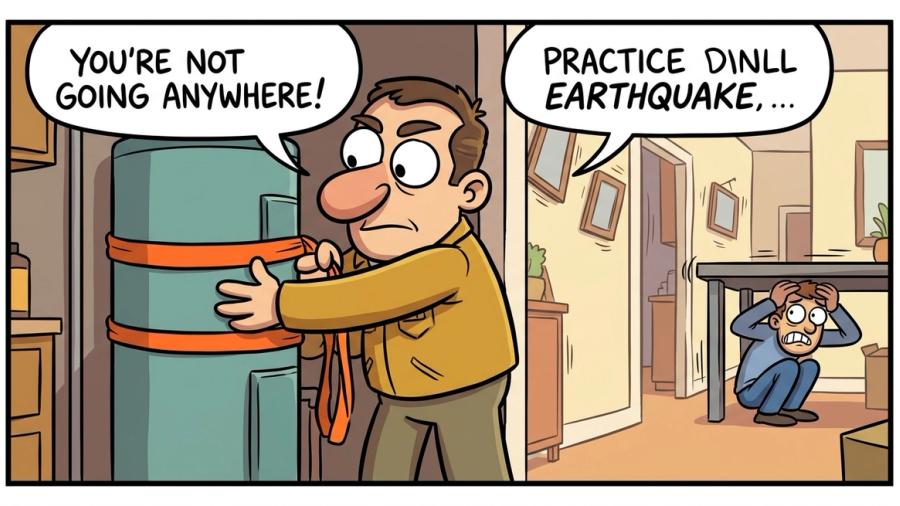
The 2026 Great California ShakeOut takes place on Thursday, October 15, at 10:15 a.m., when millions of Californians practice Drop, Cover and Hold On. It's a useful reminder for landlords that earthquake safety isn't only about drills. Some of the most important earthquake property maintenance happens long before the ground moves, and one piece of it, securing the water heater, is required by state law for every residential water heater.
The ShakeOut began in California in 2008 and is held every October. Last year, more than 10.4 million Californians took part. It's organized by the Earthquake Country Alliance, whose members include the California Governor's Office of Emergency Services, the California Earthquake Authority and FEMA. Anyone can register a drill, and it can be held on another day if October 15 doesn't work.
California's Water Heater Strapping Law
Under California Health and Safety Code section 19211, all new and replacement water heaters, and all existing residential water heaters, must be braced, anchored or strapped to resist falling or shifting during an earthquake. At a minimum, the water heater has to be secured according to the California Plumbing Code, or any local changes to it. Sellers of property with a water heater must also certify to the buyer that the requirement has been met.
The Legislature spelled out why it matters, and it speaks directly to rentals. It found that water heaters that tip over or have their plumbing or wiring damaged in a quake pose a serious risk of fire, explosion or electrocution, and the state's bracing guidelines add that broken water lines can cause costly property damage. The law also notes that tenants aren't authorized to strap, brace or anchor a water heater in their unit without the owner's advance approval, so in practice the job falls to the owner.
Earthquake Property Maintenance to Check Before the ShakeOut
Start with the water heaters. The state's guidelines note that building and plumbing codes call for a minimum of two sets of bracing straps on a typical residential tank, and the standard approach is one strap in the upper third of the tank and one in the lower third, secured to the wall framing. Check that straps are tight and that the tank doesn't wobble when pushed. Any heater replaced since the last inspection deserves a look too, since the law applies to replacement water heaters just as it does to existing ones.
Then look at the rest of the unit. Heavy furniture and tall shelving that came with a furnished rental should be anchored to the wall. Tenants and property staff should know where the main gas and water shutoffs are, and a shutoff wrench should be easy to find. Check exterior areas for loose items, unsecured chimneys or cracked masonry that could fall.
Finally, use the ShakeOut as a scheduling hook. Adding an earthquake checklist to the October maintenance round each year keeps it from getting forgotten, and photos of each secured water heater create a record that's useful at inspection time, during a sale and after a claim. It's a small job that protects tenants, the building and the owner.