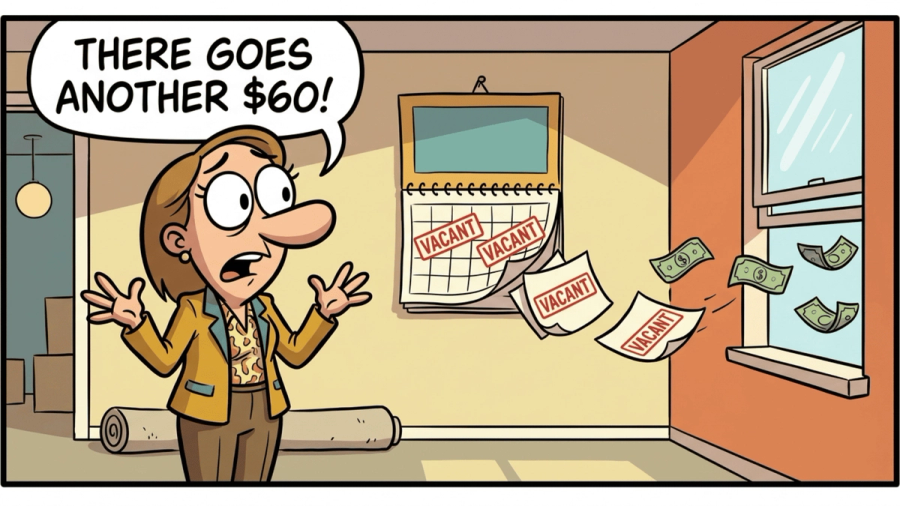
The average U.S. apartment sits vacant for roughly 34 to 41 days between one resident moving out and the next moving in, according to RealPage market analytics and multiple 2026 industry benchmarks, a gap that costs operators far more than most turnover budgets account for. It's a big part of why more operators are shifting unit turns to turnkey services rather than juggling separate trades on their own.
About 43 percent of multifamily units turn over in a given year, according to Zego's 2026 survey of 602 property managers, which put average resident retention at 57 percent, down from a peak of 60 percent in 2024. The National Apartment Association's 2024 Income/Expense IQ benchmark found turnover costs climbed 17.5 percent year over year, pushing the average full turn, including repairs, cleaning, marketing, and lost rent, to roughly $3,872 per move-out.
Where the Time Actually Goes
The physical make-ready work, repairs, painting, cleaning, and punch-list items, typically accounts for only 3 to 5 days of a well-run turn. Heavier scopes involving flooring or appliance replacement can stretch that to 10 to 21 days. The rest of the vacancy window, often the larger share of it, gets consumed by leasing time and the coordination lag between separate vendors rather than by hands-on labor itself.
That distinction matters for budgeting. On a 200-unit portfolio with average rent near $1,500 and 50 percent annual turnover, cutting the days-vacant number by 10 days recovers roughly $50,000 in annual rent, and by 20 days, more than $100,000, based on standard vacancy-cost modeling used across the industry. The biggest lever usually isn't a faster paint job. It's starting the turn at notice instead of at move-out and cutting the number of separate vendors a unit has to wait on, since every added handoff between trades tends to add a day or more of dead time to the schedule.
Where Turnkey Services Fit the Turn
That's the case for treating unit turns as turnkey services rather than a sequence of separately scheduled trades. A single crew covering paint, carpentry, flooring, and punch-list repairs removes the scheduling gaps that build up when plumbing, electrical, and painting each wait on a different vendor's availability, and it gives portfolio managers one point of contact and one property maintenance services standard across every unit moving through the pipeline. A consistent move-out property inspection at the start of the process also catches issues before they turn into delays mid-turn, since a scope that's fully known on day one is easier to schedule tightly than one that keeps growing as the turn progresses.
Turnover costs aren't likely to come back down on their own. The operators cutting the most days off their vacancy numbers are usually the ones who've simplified how many vendors touch a unit between move-out and move-in.