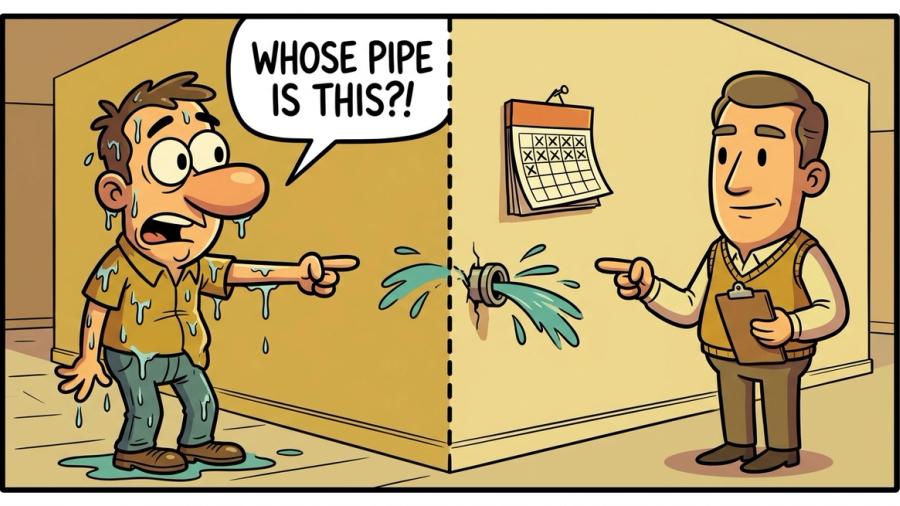
In a California condo or HOA community, the association must repair gas, heat, water or electric service that fails in the common area, even when the work reaches into a unit, and the board must start the repair process within 14 days of the interruption. Everything inside the unit stays with the owner. AB 1892 clarifies the wording of this rule starting January 1, 2027, which makes it a good time for maintenance teams and property managers to tighten how they sort these calls.
The rule sits in Civil Code section 4775 and has limits. It yields to the community’s declaration if that document says otherwise, and it does not apply where a utility provider is required to maintain the failed component. The owner of each unit remains responsible for repairing and maintaining it, and the owner of the affected unit, not the association, bears the cost of any temporary relocation during a repair.
How do you tell an HOA repair from an owner repair?
Work out where the failure starts. A burst pipe in a shared wall or a dead feeder in a common electrical room points to the association, while a failure inside a unit’s own fixtures remains the owner’s repair. A technician who arrives at a no water call should trace the problem back to the first point of failure before touching anything, and photograph what is found. Dated photos of the damage, the shutoff locations and any tenant complaints turn a phone call into a record.
Then put the report in writing the same day, because the 14 days run from the interruption. Ask the board in writing what its repair will cover, since the declaration can change the answer, and keep the board’s replies in the same file. The declaration is the community’s governing document, often called the CC&Rs, and it is worth having on hand before a failure rather than after.
What happens during the association’s 14 days?
The board has 14 days to start the process of making repairs, not to finish them. If reserves fall short, the association may take a loan from a financial institution without a member vote and levy an assessment to repay it, after the board adopts a resolution documenting the shortfall. If the board cannot reach a quorum within those 14 days, the next properly noticed meeting can use a reduced quorum for the vote to begin repairs, and directors may vote by email on starting the work.
That makes the first two weeks a paperwork problem as much as a plumbing or electrical one, and the owner of the affected unit is the one who feels any delay. A tenant without water or power still calls the owner or the property manager first, so a vendor who can handle the in-unit work as soon as service is restored shortens the gap. Because temporary relocation costs fall on the unit owner, shortening the outage matters financially as well as for the tenant.
Nest Nomads coordinates the plumbing, electrical and drywall work inside the unit once the association restores service, across Ventura County and the Sacramento region, with before and after photos on every closed ticket.